Main Points
- An AC that’s not removing humidity is a common issue, even if your home feels cool.
- Short cycling, dirty filters, and low refrigerant are major causes.
- An air conditioner that’s not dehumidifying often points to system performance issues, not just temperature settings.
- The ideal indoor humidity in summer is 30–50%.
- If your house feels humid with the AC on, it may be time for a professional service.
If your AC is running but the house feels damp, you’re probably not imagining it. Your air conditioner is supposed to do two things: cool your home and remove moisture. When it fails at the second job, you end up with that uncomfortable, sticky feeling — even when the thermostat says everything’s fine.
It’s one of the most common AC humidity problems homeowners face. The good news? It’s usually fixable once you understand what’s causing it.
Why Your House Feels Humid Even With the AC Running
So, why is my house so humid with the AC running?
When your AC is working properly, it removes humidity by pulling warm air over cold evaporator coils. As the warm air cools, the moisture condenses and drains away. If that process is disrupted, the moisture stays in the air, and your home can start to feel damp or sticky.
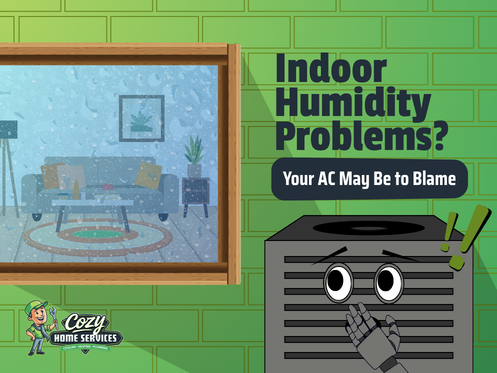
This can make your windows feel damp, lead to noticeable musty smells, and uneven comfort throughout your home.
In short, high humidity inside the house with AC on usually means your system either isn’t running long or efficiently enough to pull moisture from the air, leaving your home feeling cooler, but damp.
Common AC Problems That Cause High Indoor Humidity
Several issues can lead to indoor humidity, and air quality problems, even when your system seems to be working.
- Oversized air conditioner: An oversized unit will short cycle. It cools your home too quickly, and shuts off before it has time to remove the moisture.
- Short cycling or improper run times: If your system turns on and off too frequently, it doesn’t stay on long enough to complete the dehumidification process, and your house will feel humid with the AC on.
- Restricted airflow: Dirty air filters, blocked vents, or debris on the evaporator coil can limit airflow, reducing air conditioner humidity control.
- Low refrigerant levels: When refrigerant levels are low, the system may still run, but it won’t dehumidify effectively.
- Clogged or blocked condensate drain line: Your AC removes humidity by pulling moisture from the air and draining it away. If the drain line is clogged, that moisture can’t drain.
- Thermostat or control issues: When the thermostat is faulty or is set incorrectly it can cause your AC to “short cycle” and not run for long enough to remove moisture from the air.
| Humidity Issue | How It Causes High Indoor Moisture |
|---|---|
| Oversized Air Conditioner | Triggers Short Cycling: An oversized unit cools your living spaces down far too quickly, causing it to abruptly shut off before it has completed a full cycle. Because it doesn’t run long enough, it fails to successfully remove moisture from the indoor air. |
| Short Cycling / Improper Runtimes | Incomplete Dehumidification: If your cooling system turns on and off too frequently, it never reaches a sustained run state. Without long, steady cycles, the air conditioner can’t complete the necessary dehumidification process, making your house feel damp even while the AC is on. |
| Restricted Airflow | Chokes Humidity Control: Dirty air filters, blocked return vents, or a build-up of debris directly on your system’s evaporator coil will severely limit essential airflow. This restriction chokes the system and heavily reduces the air conditioner’s ability to pull moisture out of the air. |
| Low Refrigerant Levels | Neutralizes Moisture Stripping: When refrigerant leaks out or runs low, your air conditioning system may still keep running, but it loses its chemical capacity to cool the coils properly. As a result, it will blow air without effectively extracting humidity. |
| Clogged Condensate Drain Line | Traps Standing Water: Your system dehumidifies by pulling water out of the air and flushing it out of your home. If the condensate drain line becomes clogged or blocked, that extracted moisture has nowhere to go and fails to drain away, locking dampness into the cycle. |
| Thermostat / Control Issues | Mismanages System Runtimes: When a thermostat becomes faulty or is calibrated incorrectly, it can trick your system into short cycling. This stops your air conditioner from running long enough to effectively clear humidity out of your home. |
Signs Your AC Is Not Removing Enough Humidity
If your AC is not cooling or removing humidity, you’ll notice some or all of the following:
- Your home will feel cool but sticky.
- You’ll notice lingering humidity after the AC shuts off.
- The air inside will feel heavy or damp.
- You’ll find yourself constantly lowering the thermostat without relief.
- There will be condensation on vents or windows.
These are all indicators your air conditioner is not dehumidifying properly and needs some attention.
What You Can Check Before Calling an HVAC Technician
Before scheduling a service, there are a few safe checks you can make yourself to resolve a number of minor AC humidity problems:
- Replace or clean your air filter.
- Make sure all vents are open and unblocked.
- Check thermostat settings (avoid “fan ON”, use “AUTO”).
- Look for visible drain line clogs.
- Ensure your doors and windows are sealed.
When Indoor Humidity Means You Should Call a Professional
You should call an HVAC technician for humidity problems when:
- The problem or problems persists after basic checks.
- Your AC runs constantly but doesn’t improve comfort.
- You suspect refrigerant issues.
- Humidity is consistently above 50%.
- Your house feels humid with AC on every day.
AC Repair, Maintenance, or Replacement: Which Fix Makes Sense?
The right solution depends on the cause of your AC humidity problems.
- Repair: Best for isolated issues like low refrigerant or faulty components.
- Maintenance: Ideal if buildup or airflow issues are reducing performance.
- Replacement: Necessary if the system is outdated or improperly sized.
Whether repair, maintenance, or replacement, it starts with a technician coming out to your home. Regular maintenance appointments make sure your system continues to function normally. For repair and replacement, a technician will conduct a full system inspection to identify what’s causing the issue, and explain your repair or replacement options. If repairs are the best choice, we may be able to complete the work needed to restore proper cooling and performance that same day.
What Affects the Cost to Fix AC Humidity Problems?
Costs vary depending on:
- Type of issue (filter vs refrigerant vs system sizing).
- Age and condition of your system.
- Accessibility of components.
- Whether parts need replacement.
Simple fixes are inexpensive, but major issues (like incorrect sizing) may require system upgrades. It’s best to contact a professional air conditioning service provider to understand the issue, and your options.
Can a Dehumidifier Help If Your AC Is Not Removing Humidity?
Yes, a dehumidifier can help if your AC is not cooling or removing humidity — but it’s not always the best long-term solution.
Using a dehumidifier can be a suitable temporary solution, but not if your AC should be handling humidity already. A dehumidifier may be able to reduce high humidity inside the house when the AC is on, but it doesn’t solve underlying system problems.
How to Prevent Indoor Humidity Problems From Coming Back
To avoid recurring indoor humidity problems:
- Schedule regular AC maintenance.
- Change air filters regularly.
- Ensure proper system sizing.
- Keep drain lines clear.
- Use a programmable thermostat.
Consistent upkeep improves air conditioner humidity control and overall comfort.
Why Indoor Humidity Problems Are Common in Vacaville and Nearby Northern California Homes
Homes in Vacaville and surrounding Northern California areas often experience AC humidity problems due to:
- Warm temperatures combined with seasonal moisture.
- Homes built with varying insulation standards.
- Systems that are slightly oversized for mild evenings.
This combination can lead to AC problems, especially during transitional weather. Cozy Home Services provide air conditioning repair, maintenance and installation services for homes throughout Vacaville, CA and the surrounding area.
How Cozy Home Services Can Help With AC Humidity Problems
If your air conditioner is not dehumidifying, Cozy Home Services can help diagnose and fix the issue quickly.
We provide:
- System inspections and diagnostics.
- Targeted AC repair for humidity issues.
- Performance-focused maintenance.
- Expert system sizing and installation.
Contact Cozy Home Services today to book your service.
Frequently Asked Questions
Why is my house so humid even with the AC running?
Your house may feel humid even with the AC running because the system isn’t removing enough moisture due to short cycling, low refrigerant, or airflow issues.
Why does my AC cool the house but not remove humidity?
Your AC may cool the house but not remove humidity because it lowers temperature quickly without running long enough to pull moisture from the air.
Does a dirty air filter make indoor humidity worse?
Yes, a dirty air filter can make indoor humidity worse by restricting airflow and reducing your system’s ability to dehumidify.
Can an oversized AC cause humidity problems?
Yes, an oversized AC can cause humidity problems because it cools too fast and shuts off before removing enough moisture.
Can low refrigerant cause my house to feel humid?
Yes, low refrigerant can cause your house to feel humid because it reduces your AC’s ability to remove both heat and moisture.
When should I call an HVAC technician for humidity problems?
You should call an HVAC technician for humidity problems when your AC is running but the house still feels damp, sticky, or uncomfortable despite basic troubleshooting.